
A meadowy table arrangement may look effortless, with stems appearing to have settled naturally into place. The quiet engineering beneath it matters, though. When considering floral foam versus chicken wire, the right answer is rarely about following a trend. It is about the flowers, the vessel, the setting and how the design needs to feel when it reaches the person receiving it.
At Sweetpea Macfie, the aim is always to let seasonal flowers retain their character: a gently curving narcissus stem, the looseness of sweet peas, a hedgerow-like mix of grasses and garden blooms. That approach calls for considered mechanics. Foam and chicken wire each offer something useful, but they lead to rather different results and carry different environmental considerations.
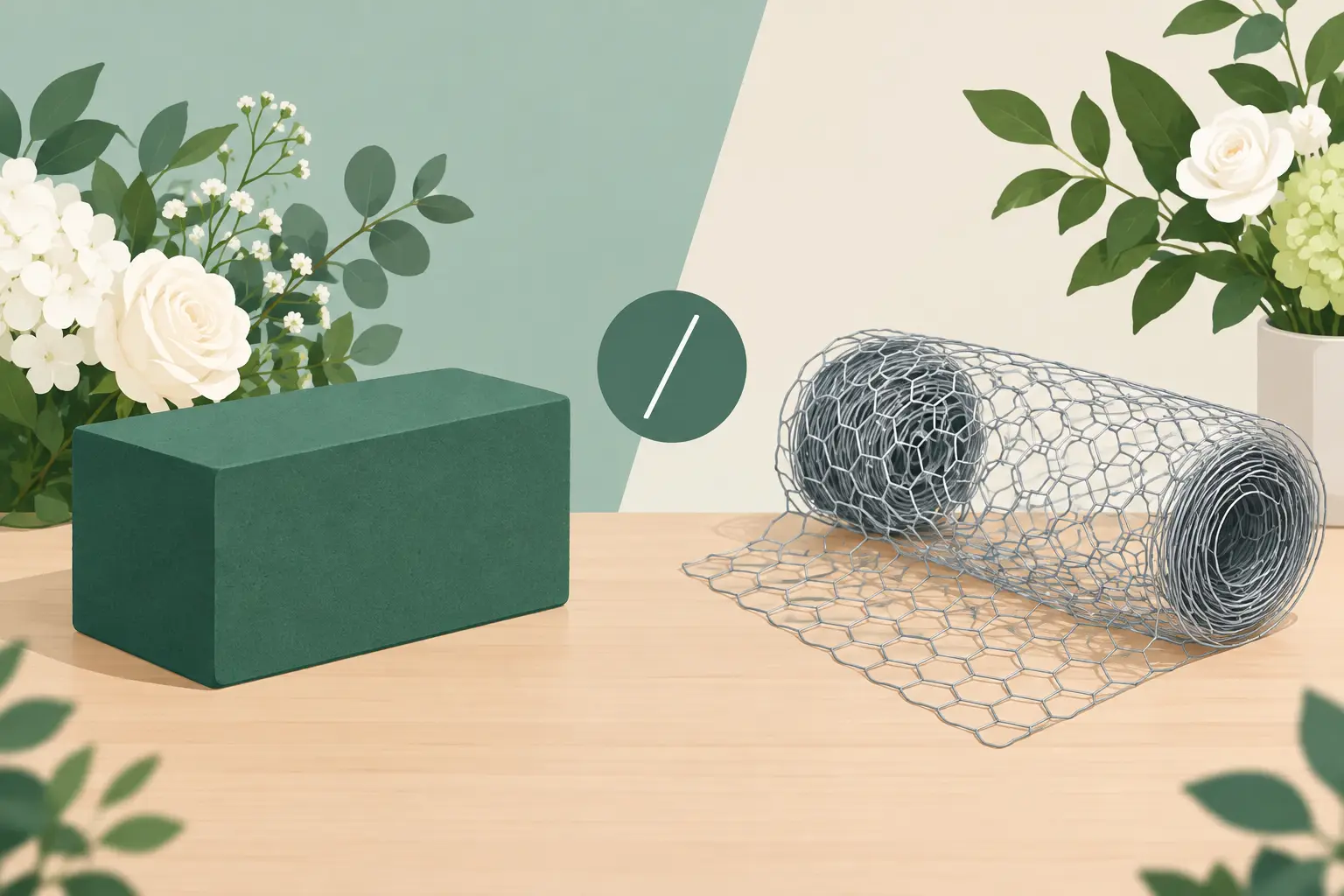
Floral foam versus chicken wire: the central difference
Floral foam is a lightweight, porous material that is soaked in water and cut to fit a container. Stems are inserted directly into it, where they are held firmly in position and can take up water. For decades, it has been a familiar part of professional floristry because it makes complex, structured work possible, particularly where the arrangement has to be transported or displayed for a long time.
Chicken wire is a reusable metal mesh, usually shaped into a loose ball or framework inside a vase or bowl. It creates a grid that supports stems while leaving them standing in clean water. Rather than fixing every stem at a precise angle, it encourages the flowers to rest against one another and find their own natural line.
This is why the choice changes more than the construction method. Foam tends to lend itself to control and density. Chicken wire tends to create movement, air and a more garden-led finish. Neither material can make flowers beautiful on its own. Good conditioning, a thoughtful flower choice and careful placement still do the real work.
Why florists are moving away from foam
The greatest concern with traditional floral foam is environmental. It is a single-use plastic product that breaks down into tiny particles rather than returning harmlessly to the soil. It cannot be composted with garden waste, and the residue can enter waterways if it is handled or disposed of carelessly.
For clients choosing British-grown, seasonal flowers and minimal packaging, this can feel at odds with the rest of the arrangement’s story. A bouquet of locally grown tulips, scented stocks and flowering branches has a lighter touch than imported, heavily packaged flowers. It makes sense to consider what is holding those stems, too.
There are practical reasons to reduce foam use as well. Once used, it is difficult to recycle, and arrangements built in foam often cannot be easily dismantled for separating flowers, foliage and container after an event. Choosing reusable mechanics wherever possible makes the process simpler and less wasteful.
That said, sustainability is not achieved by a single material swap. Chicken wire is metal, so it has an environmental footprint of its own. It is a better choice when it is reused many times, kept out of the bin and selected only where it genuinely suits the design. Responsible floristry is built on a series of considered decisions, from sourcing and seasonality to mechanics and aftercare.
When chicken wire is the better choice
Chicken wire works especially beautifully in watertight vessels such as ceramic bowls, footed compotes and generous glass vases. It is ideal for designs where the flowers should look gathered rather than arranged: an abundant wedding table centre, a relaxed mantelpiece piece, or a seasonal gift arrangement with plenty of texture.
The mesh gives stem placement without making every line rigid. Woody stems can be tucked through it securely, while softer flowers can be supported by their neighbours. A florist may also use a waterproof tape grid across the rim to give extra stability, particularly in a wide vessel.
For a wedding breakfast, chicken wire arrangements can be designed to sit low and open, so guests can see across the table. Spring blossom, cow parsley, ranunculus and tulips can all keep their sense of lightness. In late summer, dahlias, cosmos, scabious and grasses take on a lovely looseness that foam can sometimes flatten into a more formal shape.
It also allows the water to remain visible and accessible. This can help with topping up arrangements during a multi-day celebration or when flowers are displayed at home. Fresh water does not remove the need for proper flower care, but it gives stems a more natural drinking environment than foam.
A note on transport and stability
Chicken wire is not automatically the best option for every installation. A large arrangement travelling over Derbyshire lanes, or a tall urn design exposed to wind at an outdoor ceremony, needs careful testing and secure construction. The vessel must be sufficiently heavy, the wire must fit well, and the arrangement needs a sensible centre of gravity.
A good florist will never choose a foam-free method simply for the label if it leaves the work vulnerable. There are often other reusable or compostable mechanics to explore, including pin holders, moss, branches, water tubes and purpose-built reusable supports. The method should serve the flowers and the occasion, rather than becoming a performance.
When floral foam may still be considered
There are occasions where foam has traditionally offered a very practical solution. Funeral tributes are a sensitive example. Work designed to sit on a grave, travel with a coffin or withstand a long service can require substantial water retention and reliable stem security. A tribute may also need to hold a particular shape that carries personal meaning, such as a pillow, wreath or letter.
Even here, the conversation is changing. Many designs can be reimagined without foam, using a woven willow base, a mossed frame, fresh foliage, water sources hidden within a structure, or flowers arranged in reusable vessels. A natural sheaf, for instance, can be deeply expressive without relying on a rigid formal shape. It can be made with flowers that reflect a garden, a season or a loved one’s character.
However, there is no virtue in making bereaved families feel they must choose a less suitable tribute at an already difficult time. The most appropriate funeral flowers are those that feel right for the person being remembered and can be made with care. A knowledgeable florist can explain the options gently, including where a completely foam-free approach is possible and where a compromise may be worth discussing.
Foam may also appear in certain large-scale commercial or event installations where safety, timing and hydration present unusual challenges. These uses deserve scrutiny, not automatic acceptance. The useful question is: can the same result be made with reusable, recyclable or lower-impact mechanics? Very often, with enough planning, it can.
The effect on flower choice and design
Flowers do not all behave in the same way. A strong, woody stem such as lilac, viburnum or garden rose can work well through chicken wire. Delicate stems such as anemones, fritillaries or sweet peas need a gentler hand and thoughtful supporting stems around them. Some flowers simply prefer shallow water or individual water tubes, especially in warm conditions.
Floral foam can make it easier to place short stems or create a densely flowered face. Yet density is not always the same as abundance. A design made with fewer, carefully chosen stems can feel generous when it has varied height, texture and breathing space. This is one reason seasonal British flowers work so well with foam-free techniques: their quirks, bends and changing stages add life to an arrangement.
For gift flowers, a hand-tied bouquet in a vase is often the most straightforward answer of all. It avoids unnecessary mechanics, keeps flowers in water and gives the recipient an easy way to enjoy them. For weddings, arrangements can be planned around vessels that are part of the design from the beginning, rather than treating the container as an afterthought.
What to ask your florist
You do not need to arrive with a technical brief. It is enough to say that you would prefer lower-waste or foam-free flowers, then describe where they will be displayed and what you hope they will feel like. A florist can advise on the balance between sustainability, seasonality, budget and longevity.
For a wedding, it helps to mention whether flowers will move between ceremony and reception, whether the venue is warm or outdoors, and whether you are hoping to reuse arrangements afterwards. For funeral flowers, share any wishes about natural materials, favourite garden flowers or colours that hold meaning. These details often shape a more personal tribute than a prescribed form ever could.
The loveliest floral work is not made by forcing every stem into the same position. Give the florist a clear sense of the occasion and the values that matter to you, and allow the season, the vessel and the flowers themselves to guide the rest.
 I’m Marie,
the florist behind Sweet Pea Macfie.
I began Sweet Pea Macfie in 2018 and am a qualified florist with over 13 years’ experience.
The name is an ode to my Grandad, John Macfie, who in his day was one of the best Sweet pea growers in the country. He exhibited at all the major flower shows, and his Chelsea Gold Medal is one of my most treasured possessions, so you could say that growing and arranging flowers is in my blood.
I’m Marie,
the florist behind Sweet Pea Macfie.
I began Sweet Pea Macfie in 2018 and am a qualified florist with over 13 years’ experience.
The name is an ode to my Grandad, John Macfie, who in his day was one of the best Sweet pea growers in the country. He exhibited at all the major flower shows, and his Chelsea Gold Medal is one of my most treasured possessions, so you could say that growing and arranging flowers is in my blood.