
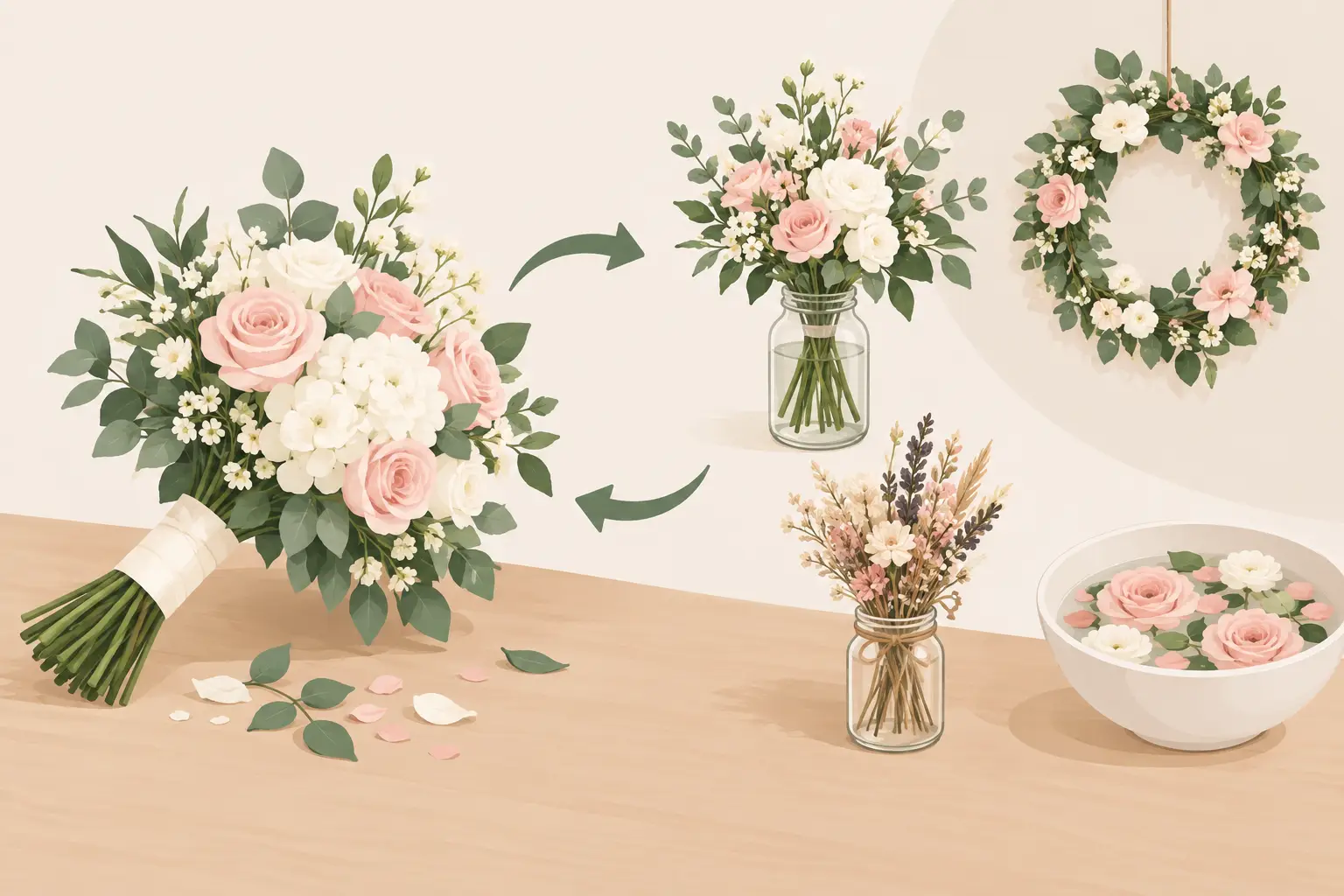
The last dance is over, the cake has been cut, and the flowers are still quietly doing their work. Knowing how to reuse wedding flowers means those carefully chosen stems can bring beauty to the morning after, a family home, or a thank-you gesture that lasts beyond the celebration. With a little planning, wedding flowers need not be a fleeting part of one very happy day.
For naturally styled, seasonal arrangements, this is especially worthwhile. Garden roses, sweet peas, cosmos, dahlias and foliage often have plenty of life left in them when they are handled well. The key is to make a plan that respects the flowers, the practicalities of the venue and the pace of the day.
Plan to reuse wedding flowers before the wedding
The best reuses are decided while the flowers are still being designed. Mention your hopes to your florist during the planning stage, rather than trying to organise everything at midnight after the reception. They can suggest vessels that are easy to lift and rearrange, flowers with good vase life, and designs that can travel safely.
A meadow-like ceremony arrangement can be created in separate water-filled vessels, for example, rather than as one large fixed installation. After the ceremony, those individual arrangements may be carried to the reception tables, placed around the bar, or taken home by loved ones. This approach also suits foam-free floristry, where flowers are arranged in water rather than set into single-use floral foam.
It does depend on the setting. Flowers used outdoors in strong sun, wind or rain may be less suitable for rehoming than arrangements kept inside a cool church or reception space. Equally, a large floral arch may look effortless in photographs but can take time, skill and several pairs of hands to dismantle safely. A collection of smaller, beautifully considered designs is often more flexible.
Move ceremony flowers to the wedding breakfast
Reusing ceremony flowers at the reception is one of the simplest and most effective choices. It allows you to enjoy your floral budget in two different spaces, and gives the reception room the same sense of occasion without doubling up on arrangements.
Pedestal designs can sit at the entrance to the wedding breakfast, beside the top table, or near the cake. Meadow arrangements may be divided between the bar, guestbook table and quieter corners of the room. If you have chosen pew ends or chair posies, these can be gathered into larger vessels at the reception, provided the stems are still in water and the designs are not too delicate to move.
Ask someone reliable to oversee the transition. This might be a venue coordinator, a member of the wedding party or your florist, depending on the service agreed. Clear instructions matter. Flowers should be carried by their containers, not lifted by stems or foliage, and should be kept away from radiators, direct sunshine and busy doorways.
Let bouquet flowers do a second job
Bridal and bridesmaid bouquets can be displayed during the meal rather than left on a chair or in a bedroom. A simple vase on the top table or beside the cake gives them a second moment and keeps stems hydrated. If you would prefer to preserve your bouquet afterwards, ask for a separate vase of water and place it somewhere cool as soon as photographs are finished.
Gift flowers to the people who helped make the day
At the end of a wedding, flowers can become a lovely, personal thank-you. Smaller table arrangements are ideal for parents, grandparents, readers, musicians, suppliers staying late, or friends who have travelled a long way. There is something rather special about taking home flowers that were part of the day, particularly when they have been selected for their seasonality and character.
Do not feel obliged to give every arrangement away. Choose the pieces that will travel well and are already arranged in suitable containers. Small bud vases, jars and bottle arrangements are particularly easy for guests to carry. Larger centrepieces may need decanting into smaller vessels first, or they may be better suited to a nearby home, care setting or community space.
If you are planning this, set aside a small number of plain paper wraps, string and flower food sachets. Minimal packaging is usually all that is needed. A brief note thanking someone for being part of the day turns a simple posy into a meaningful keepsake.
Donate wedding flowers thoughtfully
Flowers can also bring real comfort and cheer when shared locally, but donation works best when arranged in advance. A care home, hospice, community café, village hall or place of worship may be delighted to receive arrangements, yet they may have restrictions around delivery times, containers, allergies or flower condition.
Speak to the organisation before the wedding, and be realistic about what can be accepted. Arrangements should be fresh, clean and easy to manage. Remove tired blooms, damaged foliage and anything with pins or wiring exposed. For a care setting, smaller, low arrangements are often more useful than one dramatic display that needs a large table.
Avoid passing on flowers that have been heavily sprayed, are shedding pollen, or contain plants known to be toxic around pets or children if you are unsure where they will be displayed. Your florist can advise on suitable stems. The gesture is generous, but it should never create work for the recipient.
How to reuse wedding flowers at home
The day after the wedding can feel surprisingly quiet. Bringing a few arrangements home is a gentle way to hold on to its atmosphere without trying to recreate the whole event. Start by removing any spent flowers and recutting the remaining stems at an angle with clean, sharp scissors or secateurs.
Use scrupulously clean vases filled with fresh water and the flower food supplied by your florist. Strip any leaves that would sit below the waterline, then place the arrangements somewhere cool and away from fruit bowls, sunshine and heat. Ripening fruit releases ethylene gas, which can shorten the life of flowers, especially delicate seasonal varieties.
Rather than keeping one large centrepiece intact, divide it across the house. A few stems on a bedside table, kitchen table or hall console can feel more natural and will often last longer in smaller, fresh vessels. This is also a good opportunity to enjoy the detail of the flowers: the movement of a grass, the scent of a rose, the unfolding centre of a dahlia.
Press, dry or preserve a few special stems
Not every flower dries beautifully, and that is perfectly all right. Choose a small number of meaningful stems rather than attempting to preserve an entire bouquet. Roses, limonium, nigella seed heads, lavender, grasses and many foliages can dry well when hung upside down in a dark, dry, well-ventilated room.
For pressed flowers, select flatter blooms and foliage at their freshest. Place them between sheets of plain paper inside a heavy book, changing the paper after a few days if it feels damp. Once dry, they can be framed, used in a wedding album or made into simple place cards for an anniversary supper.
Professional preservation is another option for a bouquet with particular sentimental value. It is worth researching and booking this before the wedding, as the flowers will need to be delivered promptly and in good condition. Preservation is an investment, so it may be best reserved for the bridal bouquet or a few standout flowers rather than every arrangement.
Compost what has finished its moment
Part of sustainable flower use is accepting that fresh flowers are temporary. When blooms have reached the end of their vase life, remove ribbons, wire, floral tape and non-compostable mechanics, then compost the plant material where possible. If you do not have a home compost bin, check what your local green-waste collection accepts.
British-grown, seasonal flowers have a particular honesty to them. They open, fade and change, just as the garden does. Letting them return to the compost is not wasteful when they have been enjoyed fully and disposed of thoughtfully.
A wedding is full of things that are meant to pass: music, speeches, a full dance floor, the last candle burning low. Your flowers can be part of that story for a little longer, whether they brighten a grandmother’s kitchen, welcome guests at the reception, or leave a pressed petal tucked into a favourite book.
 I’m Marie,
the florist behind Sweet Pea Macfie.
I began Sweet Pea Macfie in 2018 and am a qualified florist with over 13 years’ experience.
The name is an ode to my Grandad, John Macfie, who in his day was one of the best Sweet pea growers in the country. He exhibited at all the major flower shows, and his Chelsea Gold Medal is one of my most treasured possessions, so you could say that growing and arranging flowers is in my blood.
I’m Marie,
the florist behind Sweet Pea Macfie.
I began Sweet Pea Macfie in 2018 and am a qualified florist with over 13 years’ experience.
The name is an ode to my Grandad, John Macfie, who in his day was one of the best Sweet pea growers in the country. He exhibited at all the major flower shows, and his Chelsea Gold Medal is one of my most treasured possessions, so you could say that growing and arranging flowers is in my blood.