A bouquet can be lovely and still not feel like the right gift. A wedding can have beautiful flowers but lack the small details that make the setting feel like the couple. A funeral tribute can be carefully made yet somehow miss the person being remembered. This is where a personal florist service makes a quiet but meaningful difference: it begins with listening, then creates flowers that belong to the moment.
For significant occasions, flowers are rarely just decoration. They carry affection, welcome guests, soften a difficult room, bring a garden into a celebration and say things that can be hard to put into words. Choosing a florist who takes time to understand the brief can make the whole experience feel more settled, as well as more beautiful.
What a personal florist service is – and is not
A personal florist service is not simply selecting a design from a catalogue and changing the ribbon colour. It is a one-to-one approach to floristry, shaped by the occasion, the recipient, the setting and the season. The florist brings professional knowledge, but the starting point is always the people involved.
That might mean asking a bride how she wants to feel when she walks into her ceremony, rather than only asking for a list of flowers. It may mean speaking gently with a family about a garden their father loved, the colour of their mum’s favourite cardigan, or the stems that were always growing by the back door. For a gift bouquet, it could be as simple as understanding whether the person receiving it enjoys a wild, hedgerow feel or prefers something calm, tonal and sculptural.
The result should not feel over-designed or generic. It should feel considered, natural and appropriate.
A personal service also does not mean that every flower can be promised at every time of year. In fact, an honest florist will explain where the season leads the design and where there may be alternatives. British sweet peas in early summer, garden roses in high summer, dahlias in late summer and branches, berries and textural foliage in autumn each bring their own character. Working with this natural rhythm often produces arrangements with far more life than designs built around a fixed, year-round recipe.
Why guidance matters as much as the flowers
Most people commissioning flowers are not expected to know the names of every bloom, how many stems a table needs or which varieties will hold up in a warm venue. They need someone who can make thoughtful decisions without making the process feel intimidating.
Good guidance starts with the practicalities. What is the setting like? Is the ceremony indoors or outdoors? Will the flowers need to travel? Is there a favourite colour, or simply a colour to avoid? For a funeral, are there family members contributing different ideas? For a gift, is the bouquet intended to make a bold gesture or offer a quiet show of care?
From there, a florist can translate a few feelings and references into a clear visual direction. Texture, movement and proportion matter just as much as colour. A loose arrangement of meadowy stems may suit a relaxed Derbyshire wedding in a village hall, while a more gathered, elegant design might sit beautifully in a country house dining room. Neither is better. The right choice depends on the people, the place and the atmosphere they want to create.
This guidance can also prevent costly or disappointing choices. A florist may suggest avoiding heavily scented flowers on close dining tables, choosing sturdier stems for a summer celebration, or using water-filled vessels rather than floral foam for a more sustainable approach. These are the details that are easy to overlook until they matter.
A personal florist service for life’s important moments
Weddings with a sense of place
Wedding flowers work best when they feel connected rather than scattered across a list of separate items. A bridal bouquet, buttonholes, ceremony flowers and table arrangements can share a gentle thread: a colour, a flower variety, a particular shape of foliage or a feeling of looseness and movement.
Personal does not have to mean elaborate. Sometimes it is a small posy of flowers grown in colours that recall a grandmother’s garden. Sometimes it is using flowering branches from the season to frame a ceremony space, then moving them to the reception so that the flowers continue to be enjoyed. It can also mean editing ideas with confidence. Not every surface needs to be covered in flowers for a wedding to feel abundant.
A considered florist will help couples decide where flowers will have the greatest effect. This may be the entrance guests first see, the place where vows are exchanged, or the tables where everyone will sit for the longest part of the day. Careful placement can be more memorable than a larger quantity of flowers spread too thinly.
Funeral flowers with sensitivity
Funeral flowers require a different kind of attention. There is often little time, and families may be making decisions while tired, upset or unsure of tradition. A calm conversation can make the process much easier.
Personal funeral flowers need not be formal to be respectful. A seasonal sheaf, a natural garden-inspired wreath or a casket spray filled with meaningful colours can offer a beautiful farewell. The most fitting design is one that reflects the person and gives the family comfort, rather than one chosen because it is expected.
Sustainable methods can matter here too. Foam-free arrangements, reusable containers and minimal unnecessary packaging are practical choices that sit well with a tribute made in memory of someone loved. They do not lessen the finish or care in the work. They simply ask more of the florist’s skill and planning.
Gifts that do not feel like an afterthought
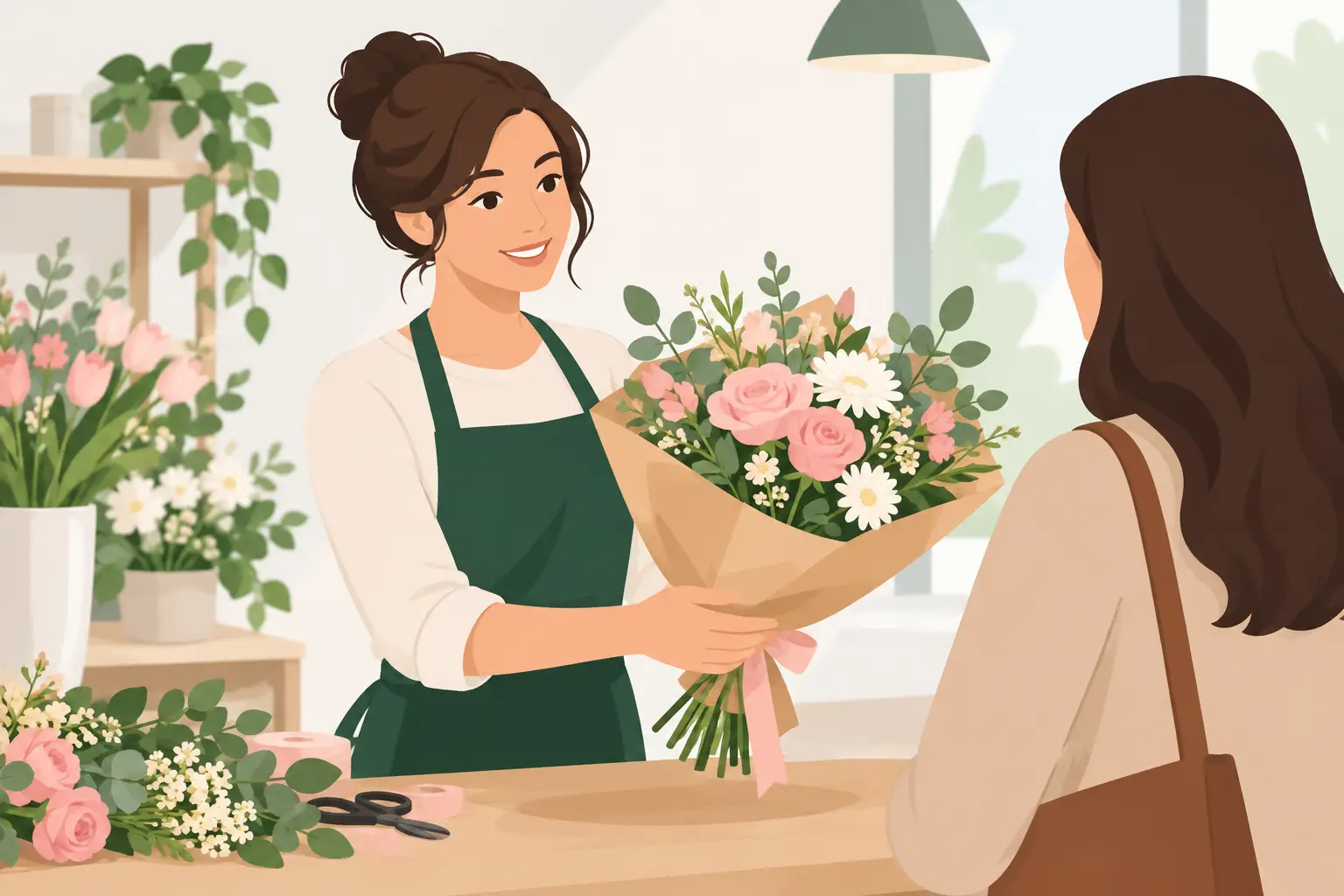
A hand-tied bouquet is often sent when words feel insufficient: a thank you, a new home, a birthday, an apology, a difficult week. The difference between a standard bunch and a thoughtfully chosen bouquet is not always about size. It is about the sense that somebody has noticed.
Seasonal gift flowers offer that feeling naturally. Spring may bring scented narcissi, tulips and blossom. Summer has its own generosity in sweet peas, cosmos and garden roses. In autumn, dahlias, grasses and seed heads offer richness without heaviness. Winter can be about evergreen texture, berries and elegant dried elements alongside fresh flowers.
At Sweetpea Macfie, this preference for seasonal, predominantly British-grown flowers is part of creating arrangements with provenance and character, rather than reproducing the same bouquet week after week.
The value of seasonal and British-grown flowers
Choosing British-grown flowers is not about insisting that every stem must be local at all costs. There are times when a particular flower is unavailable, and clients may have a meaningful request that calls for a wider choice. It is about making the season the first consideration, then being transparent about what is possible.
When flowers are grown closer to home and used in season, they often arrive with freshness, fragrance and an individuality that is hard to replicate. They may have a more natural stem length, a less uniform shape or a slight variation in tone. These are not flaws. They are part of what makes a bouquet feel alive.
There are practical trade-offs. Seasonal flowers can be less predictable, particularly when weather affects a crop. A personal florist should be able to manage this without causing worry, offering alternatives that retain the original mood rather than treating substitutions as an afterthought. Trust comes from clear communication and a willingness to work creatively with what nature provides.
How to get the most from your florist
You do not need a polished brief before getting in touch. A few useful details are enough: the date, occasion, location, a rough budget and anything that feels especially important. A photograph of a room, a fabric swatch, a favourite painting or even a description such as “soft, untamed and not too pink” can give a florist a helpful starting point.
Be honest about what you do not like as well. If you dislike lilies, do not want anything too rustic, or hope to avoid a particular colour, saying so early is valuable. It gives the design room to become more distinctly yours.
Above all, allow space for expertise. The best floral work is not a literal copy of an image found online. It responds to the light in a room, the time of year, the flowers at their best that week and the story behind the commission. When those things are given proper attention, the flowers become more than an item on a list. They become part of how the occasion is remembered.
 I’m Marie,
the florist behind Sweet Pea Macfie.
I began Sweet Pea Macfie in 2018 and am a qualified florist with over 13 years’ experience.
The name is an ode to my Grandad, John Macfie, who in his day was one of the best Sweet pea growers in the country. He exhibited at all the major flower shows, and his Chelsea Gold Medal is one of my most treasured possessions, so you could say that growing and arranging flowers is in my blood.
I’m Marie,
the florist behind Sweet Pea Macfie.
I began Sweet Pea Macfie in 2018 and am a qualified florist with over 13 years’ experience.
The name is an ode to my Grandad, John Macfie, who in his day was one of the best Sweet pea growers in the country. He exhibited at all the major flower shows, and his Chelsea Gold Medal is one of my most treasured possessions, so you could say that growing and arranging flowers is in my blood.