
A funeral tribute is often the first thing a family sees when they arrive, and the last thing they remember placing beside someone they love. Funeral flower symbols can offer a gentle way to express affection, gratitude, faith or a shared memory when words feel insufficient. Yet they are not a fixed language with only one correct translation. The most meaningful choice is usually one that reflects the person who has died, while feeling right for those saying goodbye.
At Sweetpea Macfie, conversations about funeral flowers begin with the person, not a prescribed arrangement. Perhaps they loved their garden, always wore bright colours, walked in the Derbyshire countryside, or had a favourite flower growing by the back door. Those details often carry more comfort than a strict interpretation of tradition.
What funeral flower symbols can say
Flowers have been used in mourning rituals for centuries. Their meanings have changed across places, faiths and families, so it is best to regard symbolism as a starting point rather than a rulebook. A white rose may suggest reverence and innocence to one family; to another, it simply recalls a much-loved wedding bouquet or a parent’s garden.
Colour also shapes the feeling of a tribute. White and soft green arrangements are often chosen for their sense of peace and simplicity. Gentle pinks can feel tender and loving, while blues and purples may bring a quieter, more reflective note. Warm yellows, apricots and rich autumnal tones can be especially appropriate for someone remembered for their warmth, humour or generous spirit.
There is no need for funeral flowers to be sombre in the narrowest sense. A beautifully judged collection of seasonal stems can be uplifting without being celebratory in a way that feels out of place. The balance depends on the individual, the service and the family’s wishes.
Common funeral flower symbols and their associations
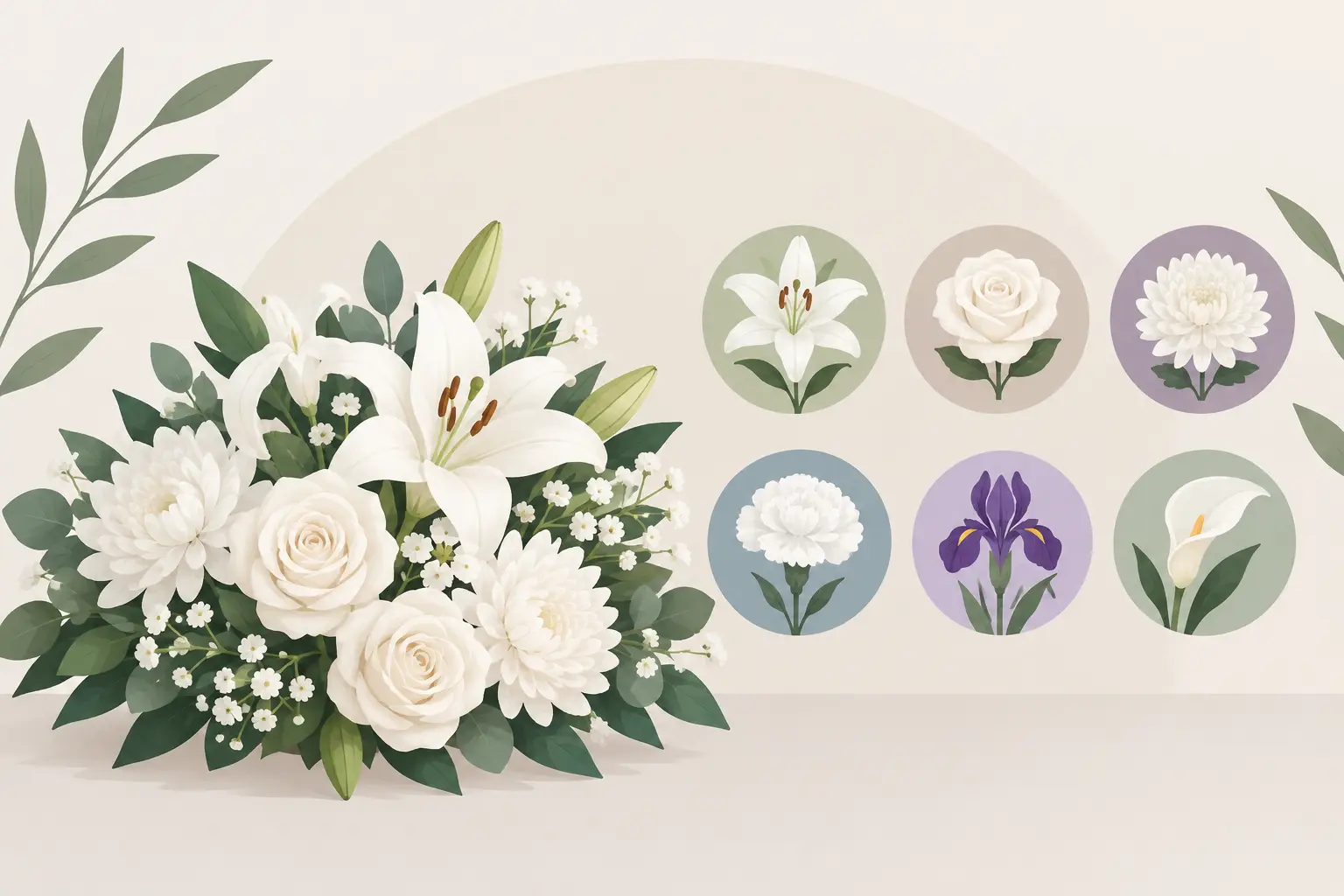
Roses: love, respect and a life well remembered
Roses are among the most familiar choices for a funeral, partly because their meaning is broad enough to suit many relationships. White roses are often associated with remembrance, humility and enduring love. Pale pink roses can express admiration and gentleness, while deeper pinks suggest gratitude. Red roses are a clear expression of love and may be chosen by a spouse, partner or close family member.
Garden roses, with their soft petals and natural scent, can feel less formal than tightly arranged florist roses. When they are in season, they bring a sense of abundance and intimacy to a tribute.
Lilies: peace, devotion and sympathy
Lilies have long been connected with funerals, particularly white varieties, which are often understood to represent peace and the restoration of innocence. Their shape and fragrance make them striking, but this is worth considering carefully. Some people find the perfume overwhelming in a church, crematorium or family home, and pollen can mark clothing.
For those who appreciate the symbolism but prefer a gentler approach, other white seasonal flowers can create the same calm impression without relying on one traditional bloom.
Carnations: affection and lasting remembrance
Carnations are enduring flowers, which is one reason they have become associated with remembrance. White carnations can suggest pure love and good fortune, while pink carnations are often linked with appreciation and affection. Their ruffled form works particularly well in a more garden-like design, where they can sit alongside roses, sweet peas, herbs and smaller seasonal flowers.
They should not be dismissed as ordinary. Carefully selected varieties have beautiful tone, scent and texture, and can be very personal when they recall a parent or grandparent’s own garden.
Chrysanthemums: loyalty, grief and honour
Chrysanthemums are a significant funeral flower in many cultures, though their meanings vary. In parts of Europe they are closely associated with mourning and remembrance. In Britain, they are often used in funeral sprays and wreaths for their long-lasting character and generous form.
They are particularly fitting for an autumn farewell, when their rich russets, berries and burnished tones can echo the season. As with every flower, cultural and religious traditions should guide the decision where relevant.
Forget-me-nots, rosemary and herbs: memory in smaller details
Not every message needs to be carried by a large bloom. Forget-me-nots are an immediate symbol of remembrance, and their small blue flowers can be tucked into a natural tribute with great tenderness. Rosemary has been associated with memory for generations and adds a fresh, aromatic note. Lavender may suggest calm and devotion, while scented geranium, mint or flowering herbs can recall time spent in a garden or kitchen.
These quieter ingredients are often where a design becomes most personal. A stem of rosemary from a familiar garden, where suitable and permitted, can mean more to a family than any formal emblem.
The shape of a tribute has meaning too
The form of funeral flowers can be as expressive as the flowers within them. A circular wreath is traditionally associated with continuity, eternity and a love without end. It can be a fitting choice from a wider family, friendship group or workplace, particularly when made with seasonal foliage and a loose, natural outline rather than a tightly uniform finish.
A sheaf or tied bouquet is a simple, graceful gesture designed to lie alongside the coffin or grave. It can feel less formal and is often chosen by friends, neighbours or colleagues. A coffin spray is usually selected by immediate family and can be designed to run the full length of the coffin or sit more modestly at one end. Its flowers offer an opportunity to tell a fuller story through colour, scent and seasonal texture.
Posies and smaller arrangements can be comforting for children or for family members who wish to contribute something personal. Letter tributes and shaped designs have their place too, especially when they genuinely reflect the person being remembered. The question is not whether a format is right or wrong, but whether it feels true to them.
Choosing flowers by season and provenance
Seasonality gives funeral flowers a sense of place and time. In spring, narcissi, blossom, fritillaries and tulips can speak of renewal, though their meaning need not be made explicit. Early summer may bring sweet peas, larkspur, campanula and scented roses. Late summer offers dahlias, cosmos and hydrangeas, while autumn brings seed heads, chrysanthemums, berries and richly coloured foliage.
Using British-grown flowers where the season allows can make a tribute feel connected to the landscape around Matlock, Bakewell and the Derbyshire Dales. It also avoids the rather impersonal look of a design assembled from the same imported stems available all year round. That said, the season is not the only consideration. If a particular flower has deep personal importance, it may be worth seeking out, even if it is not locally available at that moment.
A foam-free design can also be a thoughtful choice. It allows flowers and foliage to be arranged in reusable vessels, water sources or natural mechanics rather than single-use floral foam. For families who care about environmental impact, this is a practical way for the tribute to reflect the values of the person being honoured.
A personal story matters more than a floral dictionary
It can be tempting to search for the perfect symbolic flower, particularly when arranging a funeral under pressure. But symbolism is most powerful when it is joined to a real memory. A yellow rose for a cheerful aunt, a few stems of lavender for a keen gardener, meadow-like flowers for someone who loved walking, or a design in the colours of a favourite scarf can all say something recognisable and particular.
If you are choosing on behalf of several people, it helps to begin with a few simple questions. What was their home like? Did they prefer understated things or generous, colourful ones? Were there flowers they grew, gave or wore? What should the tribute make people feel when they see it? Those answers give a florist far more useful direction than a list of flowers with prescribed meanings.
There are practical considerations too. A church service, woodland burial, crematorium and home farewell may each call for different scales and mechanics. Some venues have restrictions on what can remain after the service. Florists can advise on this, as well as on flowers that travel well, scent levels and designs that can be divided into smaller posies for family members afterwards.
The kindest floral tribute rarely tries to say everything. Choose the colours, flowers and form that bring one person clearly to mind, and let that quiet recognition do the speaking.
 I’m Marie,
the florist behind Sweet Pea Macfie.
I began Sweet Pea Macfie in 2018 and am a qualified florist with over 13 years’ experience.
The name is an ode to my Grandad, John Macfie, who in his day was one of the best Sweet pea growers in the country. He exhibited at all the major flower shows, and his Chelsea Gold Medal is one of my most treasured possessions, so you could say that growing and arranging flowers is in my blood.
I’m Marie,
the florist behind Sweet Pea Macfie.
I began Sweet Pea Macfie in 2018 and am a qualified florist with over 13 years’ experience.
The name is an ode to my Grandad, John Macfie, who in his day was one of the best Sweet pea growers in the country. He exhibited at all the major flower shows, and his Chelsea Gold Medal is one of my most treasured possessions, so you could say that growing and arranging flowers is in my blood.