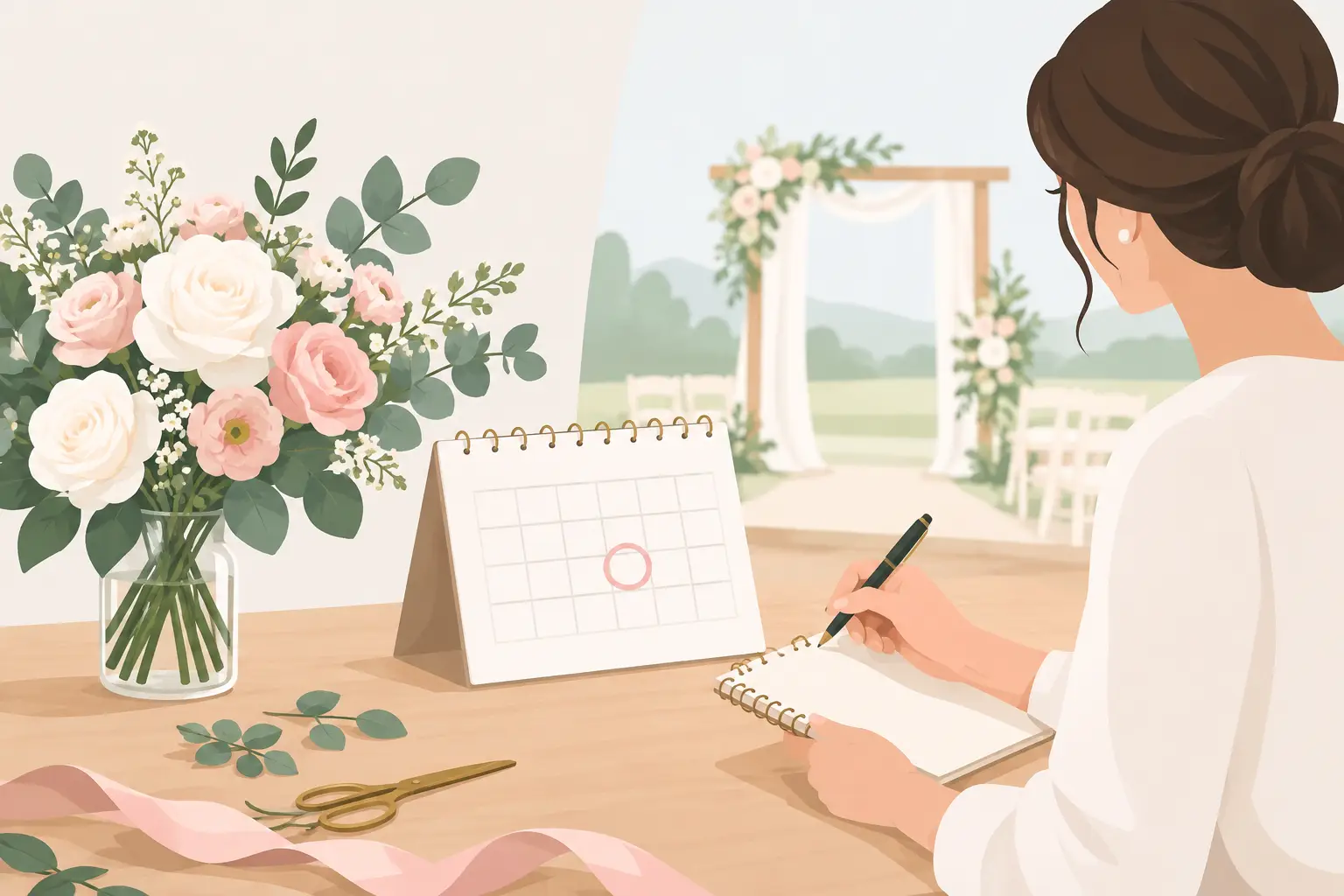
The first flowers often arrive in a couple’s imagination long before the invitations are chosen: clouds of garden roses, a trailing meadow-like bouquet, urns full of summer colour at the church door. But when should wedding flowers be ordered? For most weddings, the best time to secure your florist is once your date and venue are confirmed, ideally nine to twelve months ahead.
That does not mean every stem needs deciding a year in advance. In fact, trying to choose every flower too early can work against a natural, seasonal design. What matters first is reserving the right florist, sharing the feeling you want to create and allowing enough time for a considered plan to take shape.
When should wedding flowers be ordered for your date?
If you are marrying on a sought-after Saturday between late spring and early autumn, aim to enquire as soon as you book your venue. A florist who takes on a limited number of weddings each week may be committed many months ahead, particularly for dates in June, July, August and September.
For a wedding in the quieter months, six to nine months can be perfectly comfortable. Smaller celebrations with personal flowers only may sometimes be possible with less notice, but availability will depend on the date, the scale of the work and the flowers you have in mind. A two-week enquiry for a handful of buttonholes is very different from a request for ceremony flowers, table designs and an installation.
In Derbyshire, timing can also be shaped by the practicalities of the venue. A country house, village church or marquee wedding may involve a site visit, measurements, access arrangements and a clear plan for setting up and clearing away. Booking early creates room for those details to be handled calmly, rather than being squeezed into the final weeks.
Book the florist before finalising every detail
It is common to feel that you need a finished colour palette, a complete table plan and every bridesmaid dress chosen before speaking to a florist. You do not. A useful first consultation can happen with only the essentials: your wedding date, venue, approximate guest numbers, the parts of the day you would like flowers for and a sense of your budget.
Bring images if they help you communicate, but use them as a starting point rather than a shopping list. A photograph may show peonies at their brief May and June best, or imported flowers grown under conditions quite unlike a British summer. The most beautiful designs are usually led by atmosphere, texture and proportion, not by reproducing a single image stem for stem.
At Sweetpea Macfie, the conversation begins with how you want the day to feel. Perhaps you are drawn to gathered garden flowers, soft autumnal colour, sculptural branches or a simple, elegant scheme that lets the setting speak. From there, flowers can be chosen for the season and for the character of your celebration.
A sensible planning timeline
For larger weddings, make your initial florist enquiry around nine to twelve months before the day. After an early conversation and a provisional proposal, the overall floral direction can be agreed while you continue making other decisions.
Around four to six months before the wedding, it is helpful to revisit quantities. This is often when table numbers, ceremony plans, bridal party details and styling priorities become clearer. It is also the right point to decide where flowers will have the greatest impact. Sometimes that means a generous ceremony arrangement that can be moved to the reception; sometimes it means concentrating on the tables where guests will spend the longest.
Your final meeting or confirmation usually happens six to eight weeks beforehand. By then, a florist can refine the recipe around the best flowers expected that week, confirm delivery timings and work through practical details with the venue. Final numbers are normally needed at this stage, particularly for buttonholes, bouquets and table flowers.
Why seasonal flowers need a little flexibility
British-grown flowers bring a wedding a sense of place and time. Narcissi and fragrant blossom belong to spring; sweet peas, cosmos and dahlias carry the generous looseness of summer; seed heads, berries and rich foliage give autumn its depth. Their availability is part of their charm, but it also means nature cannot be booked with the precision of a catalogue.
A good florist can reserve the style, palette and overall floral ingredients early, then select the loveliest available stems nearer the day. This is especially valuable if you want British flowers to lead the design. Rain, heat, an early season or a late frost may affect one variety, while another arrives in abundance and proves even more beautiful.
If there is one flower you truly cannot imagine being without, mention it at your first consultation. Your florist can advise whether it is likely to be available, whether it is reliable in your wedding month and what a suitable alternative might be. Some varieties can be sourced year-round, but they may carry a higher cost, greater transport footprint or a different quality from flowers grown in season.
The aim is not to make compromises that feel disappointing. It is to build a design with enough thoughtful flexibility that it remains beautiful, natural and true to the original vision.
Order earlier for ambitious floral plans
There are occasions when earlier is better. If your plans include large-scale meadow arrangements, suspended flowers, a floral arch, several rooms to dress or a marquee needing substantial styling, enquire twelve to eighteen months ahead where possible. These designs need more than flowers: they require planning, mechanics, staffing, delivery logistics and a realistic understanding of the venue.
The same applies if your wedding falls on a bank holiday weekend, during the height of summer, or coincides with a particularly busy local events period. Florists need time to schedule the team and order appropriate vessels, structures and supporting materials. Foam-free floristry, while gentler on the environment, can also involve more careful preparation and mechanics than simply placing stems into disposable floral foam.
Early booking is not about creating pressure. It protects the possibility of making something personal and well made, rather than asking a florist to rush a design that deserves proper attention.
Let your budget guide the conversation early
Flowers are a living, hand-crafted part of a wedding, and prices reflect much more than the stems themselves. There is sourcing, conditioning, design time, vessels, sustainable mechanics, delivery, installation and collection where required. Sharing a realistic budget at the outset helps a florist recommend the right approach without guesswork.
A modest budget can still create a strong impression when it is focused. You might prioritise a memorable bridal bouquet, a few beautiful ceremony arrangements and considered table vessels, then repurpose ceremony flowers at the reception. A larger budget may allow for more abundance, fuller tables or a striking floral moment at the entrance.
It is usually wiser to be open about the figure you hope to spend than to wait until a detailed proposal arrives. A thoughtful florist will help you understand the trade-offs: more varieties versus more volume, elaborate installations versus a seasonal table scheme, or imported blooms versus locally grown flowers at their best.
What to ask before you book
Your initial conversation should leave you feeling listened to, not rushed. Ask how the florist works with seasonal availability, whether they can visit the venue, how delivery and set-up are managed, and when final numbers and balances are due. If sustainability matters to you, ask about flower provenance, packaging, reusable vessels and floral foam.
It is also useful to understand what happens to the flowers after the celebration. Some arrangements can be moved between spaces during the day, gifted to guests or taken home by family. These small decisions can make the flowers feel part of the whole occasion rather than a beautiful but fleeting backdrop.
A calm start makes room for better flowers
The best time to book is not when you have perfected every last detail. It is when you know where and when you are marrying, and you have found a florist whose work feels like you. Reserve that relationship early, then leave room for the season to bring its own quiet magic to the day.
 I’m Marie,
the florist behind Sweet Pea Macfie.
I began Sweet Pea Macfie in 2018 and am a qualified florist with over 13 years’ experience.
The name is an ode to my Grandad, John Macfie, who in his day was one of the best Sweet pea growers in the country. He exhibited at all the major flower shows, and his Chelsea Gold Medal is one of my most treasured possessions, so you could say that growing and arranging flowers is in my blood.
I’m Marie,
the florist behind Sweet Pea Macfie.
I began Sweet Pea Macfie in 2018 and am a qualified florist with over 13 years’ experience.
The name is an ode to my Grandad, John Macfie, who in his day was one of the best Sweet pea growers in the country. He exhibited at all the major flower shows, and his Chelsea Gold Medal is one of my most treasured possessions, so you could say that growing and arranging flowers is in my blood.