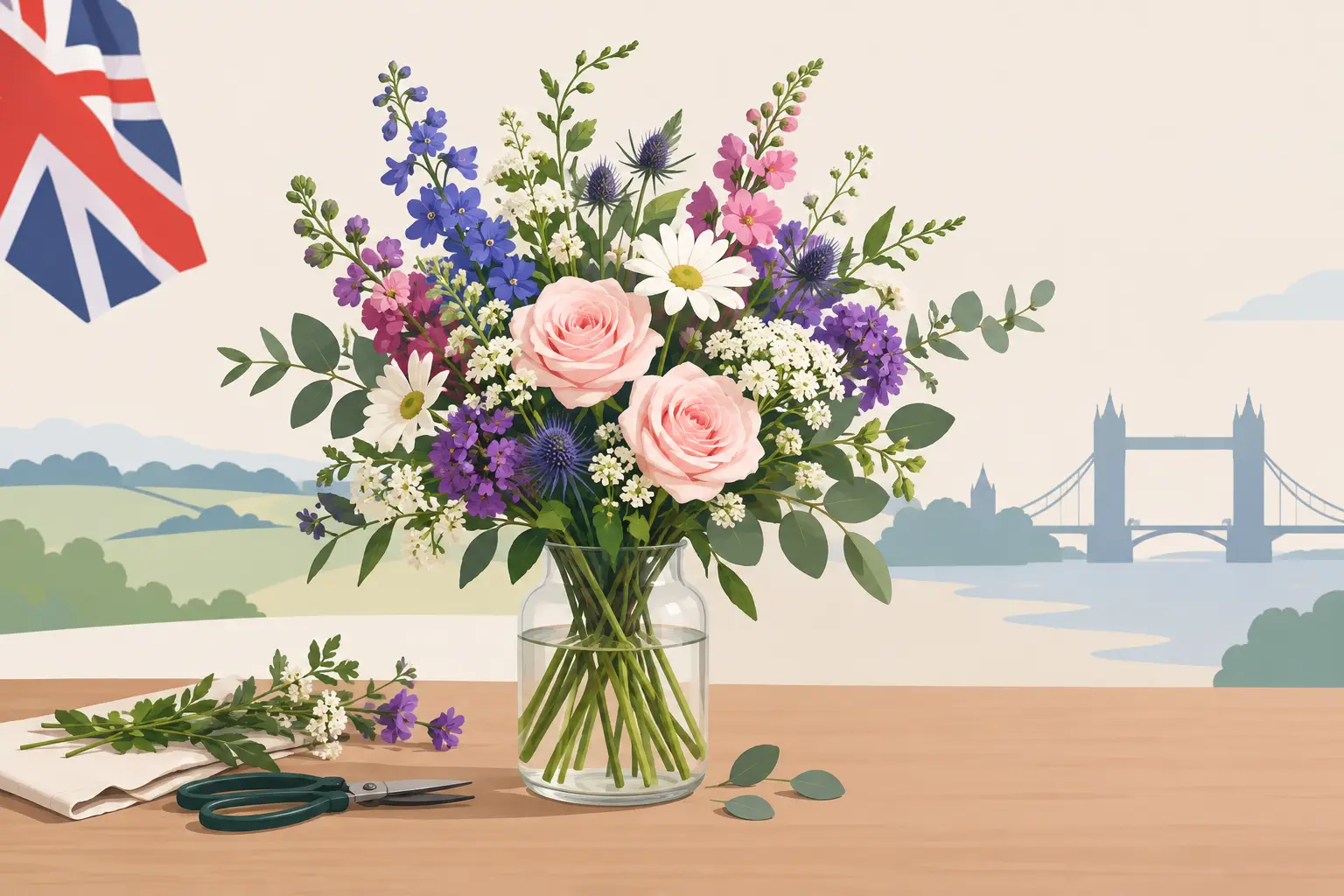
A vase of sweet peas with their softly curling stems, a garden rose that carries proper perfume, or a handful of delicate cow parsley can say far more than a tightly packed bundle of flowers flown in from afar. British flowers bring a particular sense of time and place to an arrangement. They reflect the weather outside, the character of the season, and the fleeting beauty that makes flowers worth giving in the first place.
For weddings, farewells and thoughtful gifts, this connection matters. The flowers do not need to be extravagant to feel special. When they have been chosen with care, they can feel personal, generous and completely right for the moment.
What do we mean by British flowers?
British flowers usually means flowers grown in the UK, rather than flowers that are necessarily native to Britain. A British grower may cultivate scented garden roses, dahlias, ranunculus, tulips, cosmos or zinnias alongside familiar countryside favourites. What matters is their provenance: they have been grown closer to home, in their natural UK season or under considered protected cultivation.
This is different from assuming every flower in a British-grown arrangement is a wildflower, or that every imported stem is automatically a poor choice. There are times, particularly through winter, when the British palette is naturally more limited. A florist who works seasonally will be honest about this, suggesting the best available ingredients rather than promising peonies in November or English sweet peas at Christmas.
The result is not restriction. It is a more responsive way of designing with flowers, where the ingredients lead the arrangement rather than being forced into a fixed recipe.
Why British flowers feel so distinctive
British-grown stems are often cut nearer to the point at which they are used. This can mean fresher flowers, but it also changes the character of a design. Many locally grown flowers are chosen for their scent, their movement and their individual quirks, rather than their ability to endure long-distance transport in a box.
A Dutch-grown rose may be wonderfully precise and useful for certain designs. Yet a British garden rose, with its irregular petals and changing shades, has a softness that invites a closer look. A stem of flowering mint, a fluttering cosmos or a twisting tendril of sweet pea gives an arrangement air and rhythm. These are details that make flowers feel gathered rather than manufactured.
Seasonality gives each occasion its own character
In spring, tulips, narcissi, anemones and blossoming branches bring clear colour and fresh energy. Early summer offers sweet peas, cornflowers, nigella and scented roses. High summer belongs to cosmos, scabious, delphiniums and richly coloured dahlias, while autumn brings berries, seed heads and burnished foliage.
This natural progression is valuable for life events. A May wedding can look and feel wholly different from an October celebration, without either being less beautiful. A spring bouquet might be light, leafy and full of scent; an autumn arrangement may be deeper in tone, with texture from grasses and fading foliage. Allowing the season to have a voice prevents flowers from becoming generic.
Provenance is part of the story
Knowing where flowers have come from adds another layer of meaning. For couples planning a Derbyshire wedding, British-grown flowers can echo the surrounding landscape without becoming overly rustic or themed. They may sit beautifully in a village church, a country house or a relaxed garden setting because their shapes and colours already feel at home there.
For a gift, locally and British-grown ingredients make the gesture feel considered. The recipient may not know the name of every stem, but they will notice the perfume, freshness and looseness of the bouquet. Flowers have a way of making people pause. A seasonal arrangement gives them something to notice each time they walk past it.
A considered choice, not a perfect claim
Choosing British flowers can reduce the distance stems travel and support growers working closer to home. It can also suit foam-free floristry particularly well, as garden-style ingredients and natural mechanics work together beautifully in vessels, bowls and hand-tied bouquets.
However, sustainability in floristry is rarely as simple as one label. Heating, growing methods, packaging, transport, vase life and waste all play a part. The most thoughtful approach is to use British flowers wherever the season allows, choose imported ingredients carefully when needed, avoid unnecessary packaging, and design flowers to be enjoyed rather than discarded quickly.
British flowers for the moments that matter
Weddings with a sense of place
Wedding flowers are at their best when they belong to the day rather than competing with it. British-grown flowers suit couples who want natural movement, subtle colour and arrangements that do not feel copied from a photograph. They can be refined without being stiff, and romantic without becoming fussy.
The key is to begin with feeling rather than a long list of exact varieties. Perhaps the day should feel airy and meadow-like, intimate and candlelit, or abundant but understated. From there, a florist can shape a seasonal palette around the venue, the time of year and the people wearing or holding the flowers.
There is always a balance to strike. If a particular flower has deep personal importance, such as a grandmother’s favourite bloom, it may be worth sourcing beyond the British season. If flexibility is possible, though, leaving room for what is especially lovely that week often produces the most memorable work.
Funeral flowers that feel personal
At a funeral, flowers need sensitivity as much as beauty. British flowers can bring gentleness and individuality to a tribute, whether that means meadow-like stems arranged in a woven coffin spray, a small collection of garden flowers for a family service, or a simple sheaf tied with natural twine.
Seasonal materials help a tribute feel less formal and more connected to the person being remembered. That might be soft spring blossom for someone who loved their garden, late-summer dahlias in colours they wore, or autumn foliage and berries for a warm, textural farewell. The right design does not need to say everything. It simply needs to feel truthful.
Gifts with more than a passing moment
A seasonal gift bouquet is never exactly the same twice, and that is part of its charm. Rather than receiving the same dozen stems available all year, the recipient receives a small expression of what is growing now. It could be pale tulips and blossom in March, scented sweet peas in June, or generous dahlias in September.
For the giver, this takes some pressure away from choosing. A good florist can guide the mood and colour direction, then select the best flowers available. The finished bouquet will feel far more personal than something assembled to a standard formula.
How to choose British-grown flowers with confidence
Ask your florist what is likely to be available around your date, then share what matters most: a colour family, a favourite scent, a memory, the setting, or the person the flowers are for. These details are more useful than trying to replicate an out-of-season image exactly.
It also helps to be clear about priorities. If you want the highest possible proportion of British-grown stems, say so from the outset. If abundant flowers, a particular colour or a specific bloom matters more, your florist can explain the options honestly. Good floral design is collaborative. It makes room for both practical considerations and the feeling you want the flowers to hold.
At Sweetpea Macfie, British-grown flowers are chosen for more than their provenance. They are valued for their scent, their natural shapes and their ability to make an arrangement feel alive. There is something quietly moving about flowers that belong to the season: they remind us that beauty is not improved by being available all year round.
 I’m Marie,
the florist behind Sweet Pea Macfie.
I began Sweet Pea Macfie in 2018 and am a qualified florist with over 13 years’ experience.
The name is an ode to my Grandad, John Macfie, who in his day was one of the best Sweet pea growers in the country. He exhibited at all the major flower shows, and his Chelsea Gold Medal is one of my most treasured possessions, so you could say that growing and arranging flowers is in my blood.
I’m Marie,
the florist behind Sweet Pea Macfie.
I began Sweet Pea Macfie in 2018 and am a qualified florist with over 13 years’ experience.
The name is an ode to my Grandad, John Macfie, who in his day was one of the best Sweet pea growers in the country. He exhibited at all the major flower shows, and his Chelsea Gold Medal is one of my most treasured possessions, so you could say that growing and arranging flowers is in my blood.