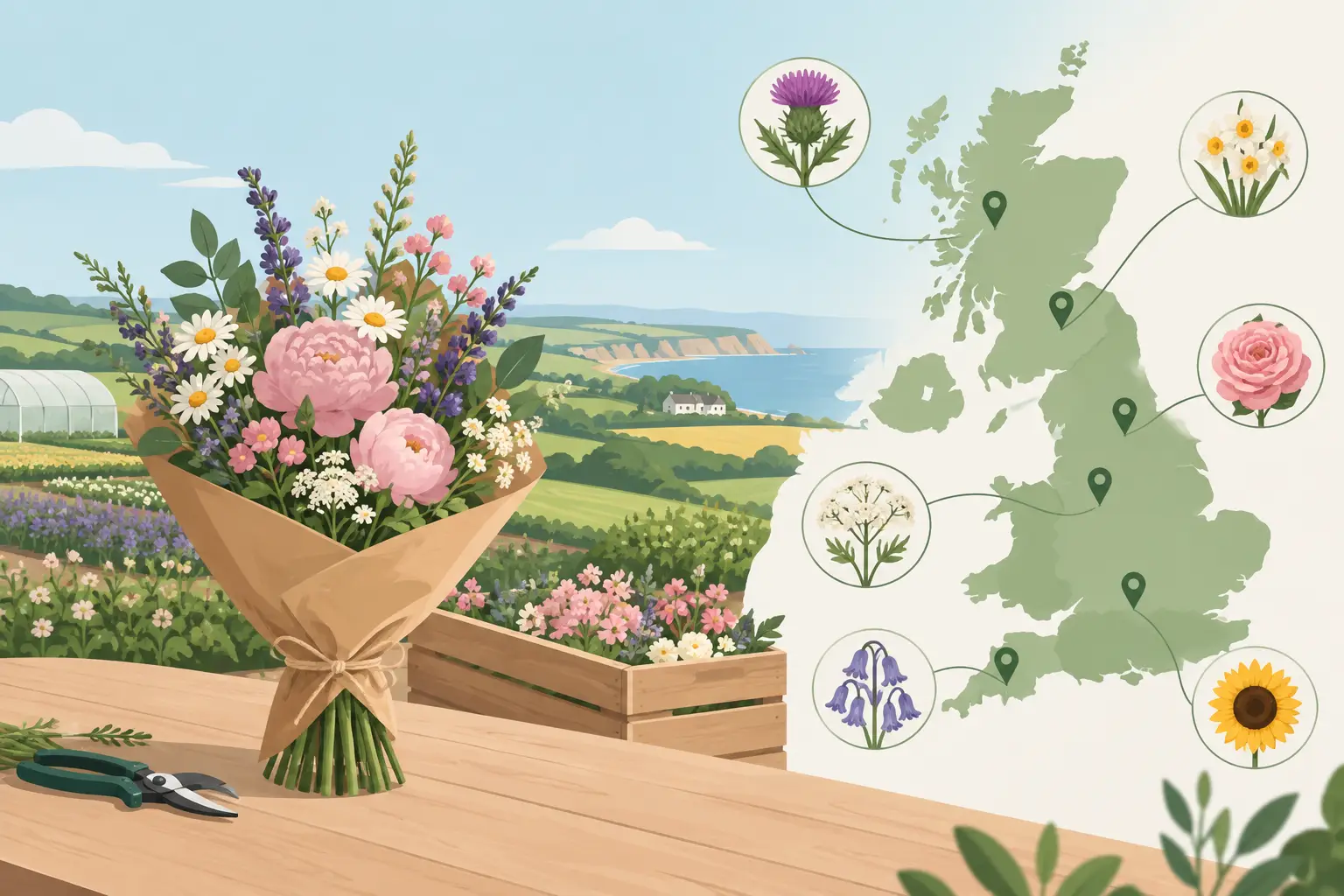
A wedding bouquet of scented sweet peas in June, a gathering of garden roses in July, or a funeral tribute made with hedgerow texture can feel unmistakably of this place. Yet the story behind each stem is not always obvious. This guide to British flower provenance explains what you are really choosing when you ask for British flowers – and why a little seasonal flexibility often leads to arrangements with far more character.
What flower provenance means
Provenance simply means where something has come from and how it reached you. In floristry, it can include the country and farm where flowers were grown, whether they were grown outdoors or under cover, how far they travelled, the materials used to arrange them, and the season in which they were naturally available.
For many people, British-grown means flowers grown in the UK by a British flower farm. That is a useful starting point, but it is not the entire picture. A stem may be British-grown yet still have been raised in a heated glasshouse, transported across the country, or supplied in plastic-heavy wrapping. Equally, some flowers that cannot be grown here at a particular time of year may be responsibly sourced from elsewhere.
The aim is not perfection or a set of rules that makes choosing flowers difficult. It is about making informed, honest decisions. A florist who values provenance should be able to talk plainly about what is in season, where possible alternatives come from, and why certain choices have been made.
Why British-grown flowers look and feel different
British flowers are often chosen for their beauty first. They have a looseness and variation that is difficult to replicate in a uniform, year-round supply chain. Stems may curve, buds may be at different stages of opening, and a bunch may contain the gentle irregularity of a garden rather than the precision of a production line.
That quality is especially lovely for weddings. Locally grown cosmos, cornflowers, scabious, sweet william and garden roses bring movement to bridal flowers, while foliage and flowering branches can create scale without making designs feel stiff or overworked. The palette also tends to reflect the time of year naturally: fresh greens and soft pastels in spring, richer pinks and sun-warmed tones in summer, then berries, grasses and burnished colour as autumn arrives.
For sympathy flowers, provenance can add another layer of meaning. A seasonal, garden-inspired design can feel quiet, personal and appropriate, particularly when the family wants to avoid something formal or generic. It may include favourite flowers where the season allows, alongside textural stems that give the tribute a sense of place and gentleness.
A guide to British flower provenance through the seasons
British flower availability changes quickly, sometimes from one week to the next. This is not a limitation to be overcome. It is part of what makes seasonal floristry feel alive.
Spring: fleeting, fresh and full of promise
Spring brings narcissi, tulips, anemones, ranunculus, blossom, scented stocks and the first delicate foliage. The exact timing depends on the weather, which is why a spring wedding date in early April can offer a very different choice from one in late May.
This is a season for softness, new growth and scent. If you have your heart set on peonies, it is sensible to discuss your date carefully rather than assume they will be available. Their British season is beautiful but brief, and a cool spring can delay it.
Summer: abundance and scent
Summer is often the easiest time to make British-grown flowers the main event. Sweet peas, roses, delphiniums, nigella, cornflowers, dahlias, scabious and cosmos bring colour, fragrance and a relaxed, natural shape.
It is also a season where flower farms can offer surprising varieties that rarely appear in high-street bouquets. A locally grown rose may not look identical to another stem in the same bucket, but that variation is part of its charm. For a bouquet intended to feel personal rather than mass-produced, it is a real advantage.
Autumn: texture, depth and gathered detail
As summer flowers fade, dahlias often continue well into early autumn, joined by chrysanthemums, asters, sedums, grasses, berries and seed heads. The mood becomes fuller and more tactile, with russet, plum, caramel and softened pink tones sitting beautifully alongside late-season foliage.
Autumn flowers are particularly suited to generous table arrangements and farewell flowers with a natural, meadow-like quality. Weather remains a factor, however. An early frost can shorten availability, so a design should always allow room for thoughtful substitutions.
Winter: restraint can be beautiful
Winter is the most limited British growing season, but it is by no means flowerless. Evergreen foliage, pussy willow, hellebores, winter jasmine, forced bulbs and seasonal branches can create arrangements with real atmosphere. British-grown flowers may form part of the design rather than every stem within it.
For December weddings or winter funerals, a provenance-led approach might mean celebrating texture, scent and line instead of expecting a summer-style abundance. A few carefully chosen imported flowers can sometimes be the most sensible complement to British foliage and seasonal ingredients. What matters is that the decision is transparent and considered.
Questions worth asking your florist
You do not need to know every flower variety to make a thoughtful choice. A good consultation should feel reassuring, not like a test. It can help to ask whether your flowers will be British-grown where possible, what is naturally available around your date, and which elements may need to come from further afield.
It is also worth asking about mechanics and packaging. Floral foam has long been common in floristry, but it is a single-use plastic material that breaks down into microplastics. Foam-free techniques, reusable vessels, chicken wire, pin frogs and carefully structured arrangements can reduce waste while still producing beautiful work. Not every design suits every method, particularly large-scale installations or tributes with practical requirements, but the conversation matters.
Finally, ask how substitutions are handled. With British flowers, a trusted florist cannot always promise an exact stem weeks or months ahead. Crops respond to rain, heat, pests and timing. The best approach is to agree a colour palette, feeling and style, then allow the final flower selection to respond to what is at its best.
British-first does not have to mean British-only
A British flower-first approach is about priority, not purity. There are occasions when imported blooms are the right choice: a much-loved flower is unavailable for a funeral, a couple have a meaningful request for their wedding, or a winter palette needs a particular focal flower. Refusing every non-British stem regardless of context can become restrictive rather than sustainable.
The key is to avoid vague claims. Flowers described as seasonal are not automatically British-grown, and flowers sold by a local florist are not necessarily locally grown. Asking the question gives you clarity, while giving your florist the chance to explain the choices behind the design.
At Sweetpea Macfie, this is the value of working with the seasons rather than trying to force every celebration into the same floral formula. A bouquet can still reflect your favourite colours, a wedding can still feel unmistakably yours, and a tribute can still honour a much-loved person – all while letting the landscape and time of year have their say.
When flowers are chosen with provenance in mind, they carry more than colour and scent. They hold the quiet assurance that their beauty belongs to the moment, and that is often what makes it memorable.
 I’m Marie,
the florist behind Sweet Pea Macfie.
I began Sweet Pea Macfie in 2018 and am a qualified florist with over 13 years’ experience.
The name is an ode to my Grandad, John Macfie, who in his day was one of the best Sweet pea growers in the country. He exhibited at all the major flower shows, and his Chelsea Gold Medal is one of my most treasured possessions, so you could say that growing and arranging flowers is in my blood.
I’m Marie,
the florist behind Sweet Pea Macfie.
I began Sweet Pea Macfie in 2018 and am a qualified florist with over 13 years’ experience.
The name is an ode to my Grandad, John Macfie, who in his day was one of the best Sweet pea growers in the country. He exhibited at all the major flower shows, and his Chelsea Gold Medal is one of my most treasured possessions, so you could say that growing and arranging flowers is in my blood.