
A funeral arrangement may have been chosen with great care: a favourite garden flower, a particular colour, or stems gathered to reflect someone’s character. Once the service has ended, it can feel difficult to leave those flowers behind. So, can funeral flowers be donated? Often, yes – but it depends on the condition of the flowers, the style of tribute and, most importantly, whether the intended recipient is able and happy to receive them.
There is no single right answer. For some families, sharing flowers brings comfort and extends a kind gesture beyond the day itself. For others, leaving a tribute in place, taking a few stems home, or returning the natural materials to the earth feels more appropriate. The best choice is the one that respects the person being remembered and is manageable at a demanding time.
Can funeral flowers be donated after the service?
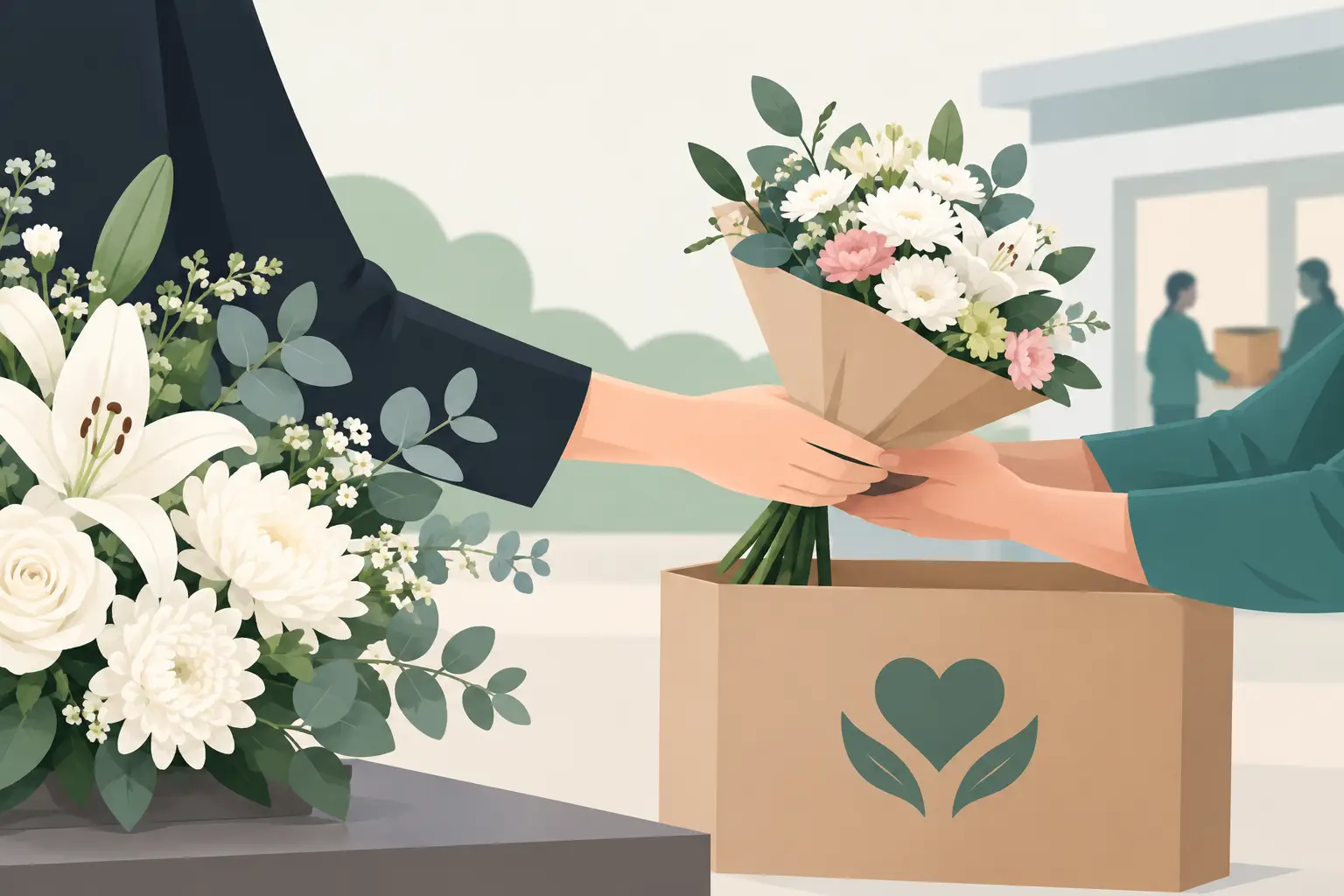
Fresh flowers can sometimes be passed on to a care home, hospice, community group, place of worship or a neighbour who would appreciate them. However, it is always wise to ask first. Many hospitals, wards and some care settings cannot accept flowers because of infection-control policies, allergies, strong fragrance or limited space. A well-meant delivery should never create extra work for staff.
A small local care home may welcome a few simple jam-jar posies for a communal table, while a hospice might prefer donations through an established arrangement rather than unplanned flowers arriving at reception. Church volunteers may be able to place suitable stems around the building. The practical detail matters: one large funeral spray is rarely useful as it stands, but several modest vessels of fresh, clean flowers may be.
Before offering anything, check with the funeral director, crematorium or church that the family may take the flowers away. At a burial, tributes are often left at the graveside for an agreed period. At a crematorium, collection arrangements vary. If you are not the person organising the funeral, ask the next of kin before moving or reusing a tribute. Flowers can hold a private significance that is not immediately visible.
Which funeral flowers are suitable to share?
The freshest, simplest blooms are usually the easiest to donate. Seasonal British flowers, foliage and garden-style stems can be gently removed from an arrangement, recut and placed in clean water. Roses, chrysanthemums, alstroemeria, carnations and hardy foliage may still give several days of enjoyment if they have been kept cool and watered.
The condition of the flowers should guide the decision. Wilted heads, bruised petals, cloudy water and tired foliage are signs that a donation may not be kind or practical. It is better to compost flowers that have reached the end of their vase life than to pass on something that will fade overnight.
There are also occasions when flowers should not be redistributed. Avoid giving away arrangements that have been exposed to rain and mud at a graveside, or that contain loose pins, wires, candles, ribbon tails or other items that could be unsafe. Be particularly cautious with lilies. Their pollen stains easily, their scent can be overwhelming in a small room, and every part of the plant is highly toxic to cats. If flowers may be displayed where pets visit, choose safer stems or leave lilies out altogether.
A large tribute can be remade with care
Many funeral designs are made as sprays, wreaths, hearts or letter tributes. These forms are meaningful at the service, but they are not always practical afterwards. A wreath can be difficult to transport, and a tribute built on floral foam cannot simply be handed on as a fresh arrangement.
If the flowers are still in good condition, a family member or florist can carefully remove suitable stems and remake them into smaller arrangements. This may be as simple as three or four posies for relatives, neighbours or a local setting that has agreed to receive them. Keep the vessels modest and stable, use fresh water, and remove tired flowers rather than trying to make every stem stretch further.
This is one reason thoughtful construction matters from the outset. Foam-free funeral flowers, created in reusable or compostable mechanics where possible, are easier to separate and dispose of responsibly once the flowers have faded. They also avoid leaving a block of single-use floral foam behind after a deeply personal occasion. At Sweetpea Macfie, this quieter consideration sits alongside the visual design: flowers should feel beautiful in the moment, but their materials deserve thought afterwards too.
Ask before you donate funeral flowers
A quick phone call can prevent an awkward or unsuitable delivery. Explain that the flowers are from a funeral, say roughly how many arrangements or stems you have, and ask whether the organisation has any restrictions. Be prepared for a polite no. This is not a rejection of the sentiment; it may simply reflect safeguarding, hygiene, staffing or space.
It can help to think beyond formal organisations. A neighbour who is housebound, someone who attended the funeral from afar, or a friend who offered practical support may value a small bunch far more than a large institution can manage. Giving a few flowers directly also allows for a more personal gesture: “These were chosen for Mum, and we thought you might like to have some at home.”
If several family members want a keepsake, divide the freshest flowers before deciding what to donate. A single stem of sweet pea, a rose, a sprig of rosemary or a piece of foliage can carry a surprising amount of meaning. There is no need to preserve everything in order to honour the day.
When composting is the more thoughtful choice
Not all funeral flowers are suited to a second home, and that is perfectly all right. Composting natural flowers and foliage is often the gentlest option, particularly after an outdoor service or when blooms are beginning to fade. Remove ribbon, cards, wire, plastic water tubes, floral foam and non-compostable decorations first. Natural stems, leaves and untreated plant material can then go into a home compost bin, where local guidance permits, or be taken to green-waste collection.
Do not add floral foam to compost or garden waste. Despite its familiar appearance, it is a plastic-based material that breaks into persistent fragments. If a tribute includes foam, separate as much plant material as possible and dispose of the foam according to local household-waste guidance.
For a family with a garden, a few flowers may be laid beneath a shrub or added to a compost heap with a moment of reflection. It need not be ceremonial to be meaningful. Returning natural materials to the soil can feel especially fitting when the tribute was made from seasonal stems, branches and foliage.
Other ways to keep the sentiment, not the whole arrangement
Sometimes donation is not the priority. A small number of flowers can be pressed between sheets of paper, dried in a dark, airy place, or photographed while they are at their best. A stem placed in a favourite vase at home may be enough. These choices work best with flowers that are already dry and clean, rather than blooms that have been weathered outdoors.
Be realistic about preservation. Fresh flowers change quickly, and not every bloom dries beautifully. A photograph of the arrangement, perhaps alongside the card or a handwritten memory, often lasts more gracefully than trying to keep a whole bouquet intact. The value lies in the association, not in making the flowers permanent.
The kindest route is usually a simple one: share fresh flowers where they will genuinely be welcomed, keep a few stems for those closest to the person who has died, and compost what has finished its brief, beautiful life. There is care in each of those choices.
 I’m Marie,
the florist behind Sweet Pea Macfie.
I began Sweet Pea Macfie in 2018 and am a qualified florist with over 13 years’ experience.
The name is an ode to my Grandad, John Macfie, who in his day was one of the best Sweet pea growers in the country. He exhibited at all the major flower shows, and his Chelsea Gold Medal is one of my most treasured possessions, so you could say that growing and arranging flowers is in my blood.
I’m Marie,
the florist behind Sweet Pea Macfie.
I began Sweet Pea Macfie in 2018 and am a qualified florist with over 13 years’ experience.
The name is an ode to my Grandad, John Macfie, who in his day was one of the best Sweet pea growers in the country. He exhibited at all the major flower shows, and his Chelsea Gold Medal is one of my most treasured possessions, so you could say that growing and arranging flowers is in my blood.