
Farewell flowers do more than fill a space at a funeral. They can reflect a much-loved garden, a favourite season, a person’s character, or simply the feeling a family wishes to offer: gratitude, tenderness and peace. If you are wondering how to arrange farewell flowers, begin there. The most moving designs are not necessarily the largest or most elaborate, but the ones that feel true to the person being remembered.
A natural funeral arrangement should have a sense of ease, as though the flowers have been gathered with care rather than constructed to a formula. That does not mean it is unplanned. It means every flower, stem and quiet detail has a purpose.
Begin with the person, not the flowers
Before choosing varieties or colours, take a little time to think about the life being marked. Was the person drawn to their garden? Did they love a particular colour, walk in the Derbyshire countryside, grow sweet peas, or always have flowers on the kitchen table? These memories can give a tribute its direction.
Sometimes the answer is simple. A gentle meadow-like design in soft whites and greens may feel right for someone who was understated and kind. For somebody lively and expressive, richer garden colour, flowing foliage and more varied texture can feel more fitting. There is no requirement for farewell flowers to be sombre. The tone should be respectful, but respect can look quiet and pale, warm and colourful, or beautifully informal.
It also helps to consider where the flowers will be placed. A casket spray is viewed from above and needs a considered shape along its full length. A sheaf is designed to rest naturally on the coffin or beside it, with stems visible and a gathered, garden-cut feeling. A vase arrangement may be chosen for the service itself, a wake, or to take home afterwards. Scale matters, but personal relevance matters more.
Choose seasonal flowers with meaning and movement
Seasonal flowers tend to make the most characterful farewell designs. They carry a particular time of year with them: fresh narcissi and blossom in spring, sweet peas and scented herbs in early summer, dahlias and seedheads in autumn, or winter foliage with hellebores and catkins.
British-grown flowers are especially lovely when they are available. Their natural variation gives an arrangement life, and they often suit a softer, more garden-led style than flowers bred for uniformity. Availability will always depend on the season and the weather, so it is wise to start with a colour mood and feeling rather than a fixed list of stems.
For a calm palette, whites, creams, soft greens and gentle blue tones are timeless. Blush pink, apricot and muted mauve bring warmth without becoming overly formal. Deeper colours can be used thoughtfully too: burgundy scabious, russet foliage, plum astrantia or dark dahlias can create depth and dignity, particularly in autumn.
Texture is as significant as colour. Delicate flowers such as cosmos, nigella or astrantia add lightness. More substantial focal blooms, perhaps roses, dahlias or peonies in season, give the eye somewhere to rest. Foliage should not be an afterthought. Ivy, scented herbs, fern, beech, eucalyptus where appropriate, or interesting branches can create movement and a connection to the landscape.
How to arrange farewell flowers naturally
A natural-looking arrangement still needs a clear structure. Start by preparing the flowers well. Use clean, sharp snips to cut each stem at an angle, remove any leaves that would sit below the waterline, and place the stems in fresh water while you work. Keep flowers somewhere cool, away from direct sun and radiators.
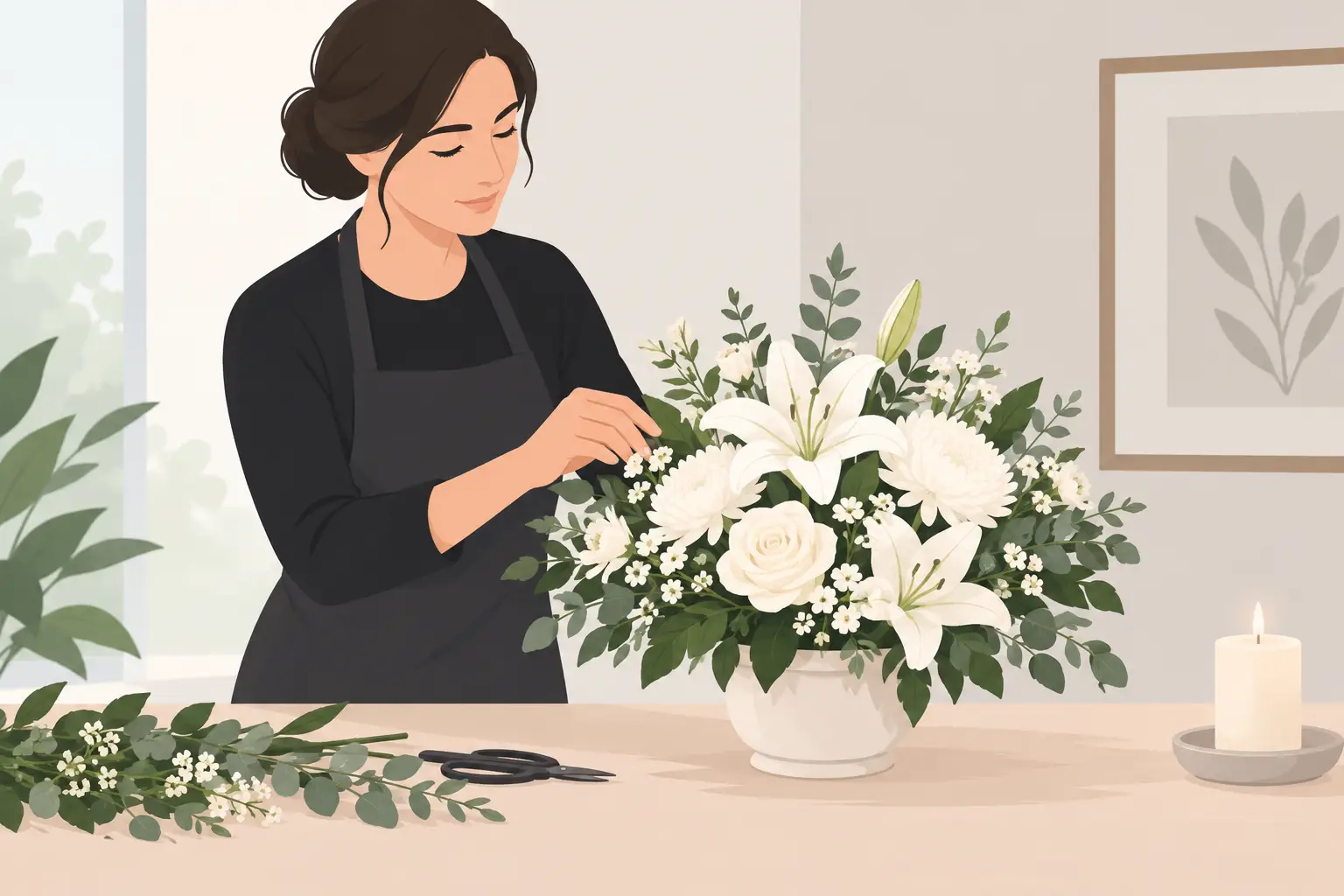
For a vase arrangement, choose a vessel with enough weight and width to support the finished design. Begin with foliage or branching stems, placing them at slightly different angles to establish an open outline. Avoid making a tight dome. Instead, allow some stems to reach a little further out, while keeping an intentional centre of interest.
Add your larger flowers next, spacing them rather than grouping every bloom in one place. Then weave in lighter, more delicate stems. Turn the arrangement as you work and view it from all sides. A farewell design should feel balanced, but it does not need to be symmetrical. A slight asymmetry often feels more natural and more expressive.
For a hand-tied sheaf, lay your chosen foliage and flowers in one direction, allowing the stems to remain visible. Build the design in layers, with larger blooms sitting lower and lighter material lifting above them. Bind the stems securely with natural twine and finish with a simple ribbon if desired. The cut stem ends can be wrapped in damp paper and a discreet waterproof layer for transport, but avoid excessive wrapping or decorative plastic.
Casket sprays require more technical consideration because they must remain hydrated, secure and proportionate throughout the service. This is usually a design best entrusted to a florist, particularly if it is a large tribute or needs to travel. A florist can create a flowing shape that sits correctly and use professional, foam-free mechanics where possible, without losing the natural quality of the flowers.
Give the arrangement room to breathe
One of the common mistakes when arranging funeral flowers at home is trying to use every stem. Space is part of the design. It allows an individual flower to be seen and gives the arrangement a restful quality.
Resist matching every bloom exactly or cutting every stem to the same length. A few airy stems rising gently above the main flowers can suggest a garden in motion. Trailing foliage or an occasional stem placed lower can soften the edge of the arrangement. The aim is not untidiness, but a considered looseness.
Scent deserves consideration too. Lightly scented roses, sweet peas, herbs or stocks can be beautiful, especially in an intimate service. In a small chapel or crematorium, however, strong fragrance may not suit everyone. If you are unsure, choose flowers for their form and meaning first, and let scent be a subtle part of the whole.
Keep practical details quiet and thoughtful
Funeral flowers need to look composed, but they also need to last well. Arrange them as close to the service as possible, keep them in water until they leave, and transport them flat and secure where appropriate. If a tribute will be outdoors in warm weather, choose resilient seasonal material and avoid delicate blooms that bruise easily.
It is also worth asking the funeral director about practical requirements. They can advise on delivery timing, chapel access and whether arrangements will be placed on or near the coffin. If the family plans to take flowers home afterwards, a vase arrangement or smaller posy may be more practical than a large traditional tribute.
Sustainability can sit quietly within these decisions. Choose seasonal flowers where possible, avoid floral foam and single-use plastic, and favour reusable vessels or natural materials. After the service, flowers can be divided among family members, placed on a grave where permitted, or composted once they have faded. These small choices can feel particularly right when the tribute is intended to honour a person who valued the natural world.
When a florist’s guidance makes a difference
At a time of loss, arranging flowers yourself can be comforting for some people. For others, it is one more decision to carry. There is no right answer. A florist can take a fragment of information – a favourite rose, a love of walking, a bright scarf, a much-tended allotment – and translate it into flowers that feel personal without asking the family to manage every detail.
At Sweetpea Macfie, farewell flowers are approached as individual commissions, with close attention to seasonality, natural form and the person behind the tribute. That may mean a loose sheaf of garden flowers, a casket spray with a quiet woodland feel, or small posies for grandchildren to carry. The purpose is never to make grief look prettier. It is to offer beauty as a sincere expression of love.
Allow the flowers to say only what they need to say. A few well-chosen stems, arranged with thought and tenderness, can hold a memory more beautifully than anything overdone.
 I’m Marie,
the florist behind Sweet Pea Macfie.
I began Sweet Pea Macfie in 2018 and am a qualified florist with over 13 years’ experience.
The name is an ode to my Grandad, John Macfie, who in his day was one of the best Sweet pea growers in the country. He exhibited at all the major flower shows, and his Chelsea Gold Medal is one of my most treasured possessions, so you could say that growing and arranging flowers is in my blood.
I’m Marie,
the florist behind Sweet Pea Macfie.
I began Sweet Pea Macfie in 2018 and am a qualified florist with over 13 years’ experience.
The name is an ode to my Grandad, John Macfie, who in his day was one of the best Sweet pea growers in the country. He exhibited at all the major flower shows, and his Chelsea Gold Medal is one of my most treasured possessions, so you could say that growing and arranging flowers is in my blood.